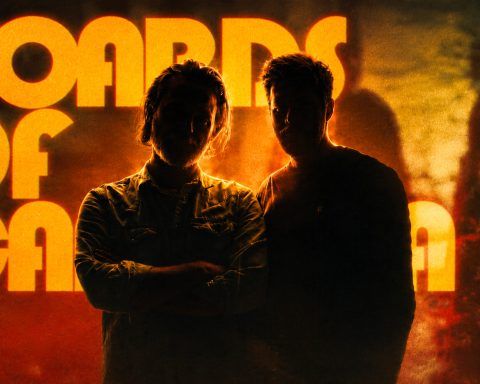
With their fifth album in 30 years, the Sandison brothers twist the neck of the idea that every ageing electronic duo must one day implode. Thirteen years after their botched exit, “Inferno” comes to right a wrong with an overstuffed tracklist and enough questions to make us want to discuss it with Principles of Geometry, a long-time Boards of Canada fan who owes plenty to the silent giants of IDM. Here, then, is the only interview you need to read about this cryptic album shaped like a door without a key.
 When was the last time the release of a so-called electronic record generated this much anticipation? Daft Punk’s “Random Access Memories”, yes, perhaps. In the family of bands capable of making people wake up in the middle of the night to swallow a new release in full, Boards of Canada can compete for a place on the podium without breaking a sweat. And it is no exaggeration to say that the announcement of a new album, thirteen years after the highly forgettable Tomorrow’s Harvest, certainly reminded the old guard of that era when people would rush to a record shop to buy the thing “physically”, as they used to say.
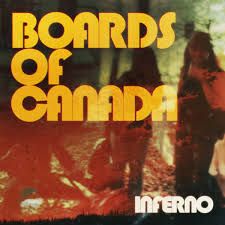
The Scottish duo, whose official career began in the mid-1990s, therefore belongs to the category of the last occult bands to have conceded not a single inch to media exposure. Rare words, blurred photographs and, as the only user manuals, records on which you never hear them speak: the best way to last without frying your brain in the sun. On that score, the latest arrival, Inferno, ticks every box perfectly: artwork in the purest BOC style, somewhere between cult and religion after a flamethrower attack, track titles lit from within and inaccessible to Jul fans (Prophecy at 1420 Mhz, I saw through Platonia) and the exhilarating feeling of a slow-motion sprint through a maze-album where one crosses paths with both Brian Eno and John Hassell’s Fourth World, Vol. 1 and some of the arrhythmic drums from Bowie’s Blackstar. In the middle of the labyrinth, lit by neon, sits a closed-circuit record where Michael Sandison and Marcus Eoin seem to engrave thirty years of sounds, atmospheres and Christ-like synths onto a Kubrickian monolith.
How are we supposed to find our way through this abyssal record? Over to Guillaume Grosso, one half of the French duo Principles Of Geometry, whose career has followed Boards of Canada’s in the background. Before a hoped-for new album, he takes the time here to decode this Inferno, where John Carpenter, astrophysics and, of course, collective suicide all come into play.
As a Boards of Canada fan, how did you react to the announcement of this new album?
Guillaume: It’s quite strange, because sometimes, when you’re waiting for an album like this, there’s a feeling of extreme solitude. Your family doesn’t necessarily understand that you’re waiting for an album so you can listen to it religiously on headphones. People who listen to less music, or less highly creative music, sometimes struggle to understand. And it’s also something that is difficult to share. I feel like bands such as Boards of Canada mostly speak inside you. Everyone has their own interpretation; it belongs to each person. There is definitely a fanbase, a very large one, but it’s as if everyone keeps it to themselves.
Thirteen years have passed since the release of Tomorrow’s Harvest. Did you really think there would ever be another album?
Guillaume: Given their silence, which is always welcome by the way — I’ve always had a deep respect for people who let the music do the talking, even if that is less convenient for journalists who want to write about them —, for me it was a possibility. But the opposite possibility, that they might remain silent forever, was just as likely.
With Boards of Canada, the music is so much in the foreground that you almost wonder whether they are two materially existing people at all. There is a huge question mark around them. I would have tended to think that yes, with age, there might be a sequel, but the window was beginning to close a little. And the nature of the elements in Inferno, like the composition as a whole, gives the impression of a medley of everything they have done: an anthology, a journey through all they have already made. You may not take it as a farewell, but you feel that the flower of youth is about to wilt.
When the first “single” came out after the album was announced, what was your first feeling?
Guillaume: A moment of nervous excitement. But I didn’t jump through the ceiling on first listen. There was the intro and the first single. The intro is a successful exercise, but quite simple. In the tracklist, there is perhaps another track that could have worked as an intro: Deep Time, which had already come out under the name Tape Five, in video form. That little synth sequence at the beginning, in “old VHS” mode, is a fanbase thing. Everyone who likes Boards of Canada and knows how to make music like that would do that. So there is an element of ease. The one that really got me into the album was Into the Magic Land. It is very simple, and I even liked the guitar, even though we can guess it isn’t exactly my cup of tea.
On first listen, however, there was a roughness to it. And above all, one aspect that didn’t entirely thrill me: one of the things I really like about Boards of Canada is the rhythmic richness, which is incredibly worked-out. Here, you had a kind of rock drum in a reverb hall. I tend to be less seduced by that. I am more touched by their melodies, their harmonies, but also by very electronic rhythms, which pull you even deeper into the journey. Here, it was a slightly more rock-drum detail. I found it a little disembodied. They have often worked with very dry sounds. At the same time, I was seduced by a fairly intoxicating sense of scale. But I didn’t find myself in the poetry, or in the second musical landscape, because there are always several readings with them. Here, I found it linear, first degree. It is well produced, but at first I didn’t really feel like I was listening to a Boards of Canada track. Then again, I think back to Portishead’s third album: I didn’t love it, but I quite liked the turn they had taken, with a much stiffer, more clinical, more disembodied sound. As if they wanted to make little snippets of Dopplereffekt-style sounds, only stiffer. There was also perhaps a memory of Big Black in there, in a way.
On Inferno, I thought a lot about John Carpenter’s film Prince of Darkness, where the future sends a message into your cortex to warn you about something. Inferno, in a sense, feels to me like the music of the future.
Listening back to the album several times, I had the impression that it was above all a record of impulses. There is something very slow about it, especially on Arena Americanada, by far my favourite track. It is sneaky: it starts very slowly and, at some point, it takes off. That gimmick comes back, but it is very precise and extremely effective. I didn’t have that impression on other records.
Guillaume: Yes, same. With the previous one, I had more of the impression of a record that was not ambient, but atmospheric. An atmosphere like a soundtrack behind a film, which emotionally didn’t bring you much. Here, there is a rigour in the swing that technically allows them to simplify things in their expression. Everything is ultimately simpler, and the swings gain a little more flavour.
I’m thinking of Naraka, which for me is the first track in the running order that really makes sense. I find it pretty successful.
Guillaume: It’s funny, because Naraka, on first listen, I discovered it at three in the morning, waking up in the middle of the night. I thought: oh, the album is out. It’s complicated to start an album like that in the middle of the night. And I have this bad habit of skipping from track to track, to get an idea before launching into a proper listen. On Naraka, this time, there is a fully respected set of Boards-of-Canadian geometry. I even accepted the Hare Krishna at the end.
That might be the track’s only problem: that slightly world-ish, poor man’s field-recording side.
Guillaume: Personally, I heard it as a nod to Aquarius. Maybe I’m over-analysing it, but in “Aquarius”, with Boards of Canada, there is already this idea of hippie, spiritual, almost ritual memory. The track notably rests on a sample of Aquarius by Galt MacDermot and Ren Woods, taken from the soundtrack of the 1979 film Hair. It is not necessarily “the bass from the beginning of the film” in the strict sense, but rather that bass riff and musical material that Boards of Canada recovered, then replayed, diverted and recomposed around their own universe. And since Hair also carries that whole Hare Krishna, countercultural, mystical imaginary — going off to the army, utopia cracking apart — I had the impression that this new passage worked like a reminiscence. Not a direct quote, more like a scrap of memory resurfacing. With them, it is often that: fragments of popular culture, bits of films, voices, rituals or buried memories returning like slightly scrambled signals.
But it is true that here, the vocal use shows a kind of simplification of effects and desires. I have always found — having experienced it myself — that at some point, even when you make electronic music, you live thanks to machines. Sometimes, you try to solve your weaknesses through sampling. Sampling then becomes a raw material of electronic music. And at a certain age, you want to free yourself from samples, to prove other things to yourself, to go further in the work, to create and compose everything yourself.
What we now call the “Daft Punk syndrome”.
Guillaume: Exactly. You arrive at something super well produced, but it no longer has the same weight. The salt is still there, but something is missing; it lacks a bit of spice. You can have that in the rhythmic scales, but also in the vocal effects. For example, Father & Son is not at all on the level of Telephasic Workshop, where the voices are so chopped up and electronic that it becomes almost a dose of acid. Here, I found the momentum fairly easy, too simple.
In the background of Inferno, I thought a lot about John Carpenter’s film Prince of Darkness, where the future sends a message into your cortex to warn you about something. Inferno, in a sense, feels to me like the music of the future. The record is scattered with transmission sounds, voices that resemble Carpenter’s little theme or little transmission phrase. Before, with them, there was a lot of this idea of the past, the future, of a retro-futurism. Here, I have the impression of a message coming from the future.
That loops nicely with the title of track two, Prophecy at 1420 MHz. Do you know what that frequency corresponds to?
Guillaume: It is a frequency linked to astrophysics, something that was supposedly once received from space and never came back. I can’t remember the exact name. There is an astrophysical side: a frequency captured from space, then never heard again. In 1959, at Cornell University, physicists Philip Morrison and Giuseppe Cocconi hypothesised that an extraterrestrial civilisation might communicate through radio signals using the 1420 MHz frequency, naturally emitted by hydrogen. And then there is also the “Wow! Signal”. Boards of Canada always have fun putting messages in their titles. For example, one of my favourite tracks, Nlogax, I only understood years later was linked to logarithms. There is always, with them, a pleasure in putting messages into titles, even a temptation towards the cult of the cult. I think people want that. Maybe with them, in a very candid way, they are completely into it. But there is undeniably a very intoxicating “Helter Skelter” aspect.
We were talking about their relationship with time: future, past, present. What bothers me with Boards of Canada is that I find it very hard to remember track names; as if the entire discography, from Music Has the Right to Children to Geogaddi, including the EPs, existed in the same space-time continuum, where everything could be listened to in a kind of year zero. Do you feel the same way?
Guillaume: Yes, there is a timeline that runs from the very beginning, from the first tapes, through to Geogaddi. I may have an advantage over you: I can recognise the machines they used, and I know which period that points to.
Over time, they had more money, and they started using more precise synths. With Geogaddi, for example, there is a form of rupture in the way they work with sounds. It is much more advanced. On the previous records, the artistic expression was already perched and sharp, but you could still sense something very bedroom music, or music coming out of a VHS tape. There was this desire to resemble a cross between Sesame Street and the sound identity of a film. On Geogaddi, the production is much more advanced. You recognise the synths less, there is less of that identifiable Prophet 5 side. They really evolved.
On this new album, you recognise the synths less, a bit like on Geogaddi. The harmonies are still there, the typical phrases, the call and response, the antiphonies: one melody answers another without necessarily overlapping it.
Then there is the Trans Canada Highway and The Campfire Headphase period. They were actually the ones who pushed Warp a little to sign Bibio, and here you can feel a more pronounced taste for guitars. When I listened again to The Campfire Headphase and Tomorrow’s Harvest before our call, I realised I was skipping every track but knew them all by heart. I didn’t think the tracks were bad. It is respectable, it is still very good. But…
We too, with Principles of Geometry, like to have a kind of listening tunnel. But on those two Boards of Canada albums, after a while, you get a little bored. There are not enough breaks, not enough fractures. There is a linearity. On one side, you have a marshmallow roasting; on the other, a kind of burning rock, slightly lifeless. Over the long duration of listening, I ended up appreciating those albums less, so I return to them less.
On this new album, are there any technological ruptures, instruments or sounds that jumped out at you?
Guillaume: Surprisingly, they bring back a few synthesizer elements, but I find the whole thing drier, rawer, with at times a more rock-oriented mix. You recognise the synths less, a bit like on Geogaddi. The harmonies are still there, the typical phrases, the call and response, the antiphonies: one melody answers another without necessarily overlapping it. You find little processes again, with the surprise of the penultimate track (You Retreat in Time and Space), which makes me think either of Parcels, or of Daft Punk in their Random Access Memories period with Nile Rodgers, because of the funk guitar.
Can we agree that 18 tracks for this new album Inferno is far too many?
Guillaume: Yes, there are too many — says the guy from the band that released a 26-track album. Some are completely dispensable. Speaking more about the order than the number of tracks, I think it could have been more coherent. The tracks are still easier to access than old Boards of Canada, but I think the order could have told something better. But at the same time, it is a mass over a long duration; maybe I’ll tell you the exact opposite in the future. I still have to work on my catechism for this album.
Like Chuck Berry changed the lives of people who wanted to make Chuck Berry, Boards of Canada and Aphex Twin are cult artists who opened up paths.
I wondered, as with rappers who put a feature on every track to saturate platforms, to what extent such a loaded tracklist wasn’t responding to a commercial idea. The record probably fits on two vinyls, which are also sold at quite high prices.
Guillaume: You can think that, quite rightly. There were the listening parties in Barcelona, in London… It wasn’t very expensive, but you were still paying eleven pounds to listen to an album for 70 minutes. I found that a bit mercantile. The record lasts 1 hour 10, which is extremely long today in terms of listening habits. But I can’t quite see what the point is.
We mentioned earlier the religious side of Boards of Canada. On Spotify, Inferno comes with a small video for each track, with this very American, crypto “true believer” rendering.
Guillaume: Yes, it lays it on thick with the idea of a group. You are part of something, of the troop, of the hippie bloc. It works very well on social media. It is extremely pushed and oriented towards a cult, whether that cult is the group’s or something broader.
Since we’re extrapolating, we could consider that the artwork of Inferno, red and chaotic, is a negative reflection of the first album Music Has the Right to Children, very blue, very naive, very Raelian. With Inferno, it feels like we have arrived at the final destination with the same photo, but burned in the fireplace.
Guillaume: When they showed the first visuals, I thought of something very collective-suicide-like. It gave off a Jim Jones impression. Then, when you listen, you lose that impression a little. But visually, they return to something very marked, as marked as their music. The last two albums were more restrained. Here, the artwork corresponds quite well to the record, because it is a little invisible: you have two photos in one, something very vaporous. And ultimately, that is the spirit you keep after listening. It is good, but it lacks substance, a body, a backbone — without being nasty, because the compositions are still very beautiful. Boards of Canada, even after all these years, are still for me a form of post-adolescence. I get the same pleasure from seeing an album come out, whatever the moment. Music Has the Right to Children and Geogaddi were real upheavals. The EPs too. Nlogax, which I listened to on vinyl, overwhelmed me. These are bands that changed my life. Like Chuck Berry changed the lives of people who wanted to make Chuck Berry and ended up opening other paths for rock. Boards of Canada, like Aphex Twin, are cult artists who opened up paths.
In the 1990s series Seinfeld, the final episode was completely botched by Jerry Seinfeld and Larry David. That led to quite a few controversies within the fanbase, with this “what if” feeling. Couldn’t we consider Inferno to be the real final Boards of Canada record, after the complete artistic failure of Tomorrow’s Harvest?
Guillaume: That’s a very good hypothesis. It erases the ending, yes, but it also creates, as I was saying, a kind of anthology of everything they have done. You have the guitar side that was there on the album before the one before last. You have the harmonies that point back to the early albums. You have the call and response of the early albums, electronic rhythms that want to remain electronic, vocal effects that can leave something to be desired, but I think that contributes to the objective: wanting to create messages without necessarily processing them until they become fully audible. It remains a beautiful whole. I also listened again to Brian Eno’s Music for Airports, because one track made me think of it, You Retreat in Time and Space: the beginning is almost Brian Eno in a church, and it is sublimely executed. I also went back to Cocteau Twins, because there are chorus-heavy electric guitars that feel very Simon Raymonde. There is the cinematic side, John Carpenter, the little messages… There is both their musical history and their own history. And in the credits, there is something fairly new: Michael Sandison is credited as the composer of everything, while Marcus Eoin is more attached to the production. It is the first time it has been presented like this to such an extent. Some fans even went down the road of thinking that one of them might be dead. People go very far.
Final question: where do you rank it among the best Boards of Canada albums?
Guillaume: Not counting the EPs, it is a solid number 3. Music Has the Right to Children is untouchable, because it has everything: the flavour, the sap, the overall idea. Starting from almost nothing, it creates that entire musical universe. The idea is too deep not to put it first. Geogaddi, for me, is the satanic counterpart to Music Has the Right to Children. When you drew the connection between the first and the last album, Geogaddi really is the red, violent counterpart. You go from blue-green to red. There is real violence in it. On Inferno, I was talking to you about cults; in Geogaddi, it is really the sect. There are, in fact, lots of references to David Koresh and the Branch Davidians.
So Inferno finishes third, not counting the EPs. Because if you count Hi Scores, Twoism and In a Beautiful Place Out in the Country, which are also huge pieces of my life as a listener, it becomes much more complicated.
Third place is still a very good score for a return to the present.
Guillaume: Yes, it is very good. It is a very beautiful album. You have to listen to it, listen to it again, and the future — or the future future — will tell whether it lasts. Unlike the two previous albums, I already have melodies stuck in my head. On Tomorrow’s Harvest, ultimately, very few. Here, yes, as an album, it is a solid 3.
Shall we talk again in 13 years?
Guillaume: We’ll talk again in 13 years.
Boards of Canada // Inferno // Warp